
The Conversations Your Team Needs That Haven't Happened Yet

We shared what we believe the five essential conversations for any team are in our last blog. We've mapped them out. We understand their power.
But here's what we've noticed over twenty+ years of working with leaders: knowing what conversations matter and actually having them are two very different things.
The gap in between? That's where teams can get stuck.
Teams don't avoid these conversations because they don't understand their importance. They avoid them because something in the leader has decided it's not the time to have them. And that can be for a host of reasons. They may believe there's not enough time. That nothing good will come of it. That it will turn into a complaint-fest. For these reasons, as well as many others, it just may not feel safe for the leader or safe for the people they lead.
And so the conversations don't happen. The things that need to be named stay buried. The team stays fractured by unspoken tension. The trust erodes quietly, like the foundation on a once-beautiful home that no one has attended to for a while - because 'it's good enough', and then becomes 'too time-consuming' or 'expensive' to fix. Teams then live with this foundation of trust crumbling away, until it's a crisis.
The Myth of Safety
You hear a lot about creating "safe spaces" for teams. I used to advocate for this too, believing that if we just designed the right conditions, set the right norms, and created enough psychological safety, people would naturally step into vulnerability and honesty.
Guess what? There are no guarantees people will step into those. It's hard and uncomfortable. And I heard this from Brené Brown first and witnessed in hundreds of teams since: you can't actually create a safe space for someone else.
Safety doesn't exist in organizations the way we imagine it. There's always risk. There's always the possibility of judgment, misunderstanding, or consequence. That's the reality of being human in a team.
What you can create is a brave space.
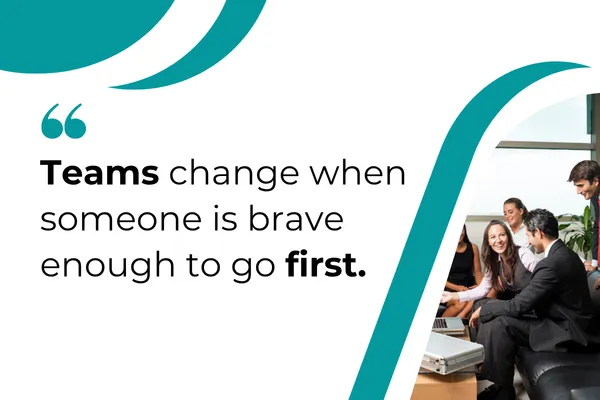
And a brave space isn't built through perfection or carefully worded norms. It's built when someone (ideally the leader!) goes first and shares authentically - from the heart about their actual lived experience.
Courage Is Contagious
I've seen this move of sharing authentically create magic over and over: when a leader is willing to be brave - to name what they don't know, to admit a fear, to say "I got that wrong" - the energy shifts in the room.
It's not because the leader has suddenly created perfect conditions or said the 'perfect' thing. It's because courage is contagious and creates a different kind of space - an invitational space - and the potential outcomes improve dramatically.
When people see their leader willing to be uncertain, willing to be wrong, willing to be human, they realize the REAL conversation might be possible. Not because it's safe. But because their leader is willing to take the risk first, share, and then invite their contributions, and really listen to learn about their experience.
I watched this happen in a team just last month. The leader stood up and said, "I don't know exactly why, but I know something feels off right now in our team. I know I'm contributing to that and I want to be part of the change to something better, I just don't know what that looks like. I'm hoping we can figure it out together."
Silence, but the good kind. You could feel the room open up. Then the real, necessary - and previously avoided at all costs - conversation started.
Not because the space suddenly felt safe. Because the leader had shown what bravery looked like. And one by one, the team met them there.Did that conversation change everything? Of course not, but it definitely started to patch the foundation.
What Leaders Going First Actually Looks Like
Going first doesn't mean oversharing or using your team as your therapist. It means:
Naming something true that makes you vulnerable. "I don't have the answer to that." "I'm worried about how this is landing with the team." "I realized last night that I handled that conversation poorly."
It means asking for what you actually need instead of pretending you have it figured out. "I need your honest feedback on how I'm showing up as a leader." "What am I missing here?"
It means letting your team see that you're also in the practice of leadership - not above it, not beyond doubt, but in it, trying to build your way, and style that works for you and the team.
When a leader does this, something bigger becomes possible. The unspoken concerns, the quiet assumptions, the things people have been holding back, suddenly they recognize there's a channel for them to come forward. Because the leader has made the first move toward trust.
The Payoff
Here's what happens when leaders create invitational conversation spaces through their own courage:
The five essential conversations, the ones about vision, clarity, energy, systems, and connection, they become real. Not theoretical. Not check boxes. Real.
People start contributing. They bring their actual thinking, their real concerns, their genuine hopes. They take responsibility for what is theirs and stop waiting for the leader to 'fix it all'. The conversations go deeper. The team becomes more coherent. And the team experience shifts. People feel like their leader really wants to hear what's true for them. They feel less alone in the work and more connected to their colleagues.
That's when trust starts to build. Not through forced safety, but through the repeated experience of a leader who is willing to be human ... and brave... first.
What You Can Do Today
This week, notice one moment where you could lead with courage first.
What's something true that you've been hesitant to name? A question you don't have the answer to? A moment where you know you missed the mark? A fear about how something is landing?
What would it look like to share that authentically with your team? Not as a confession. Not as a burden you're placing on them. But as a simple, honest acknowledgment of what's real for you.
Start there. Watch what happens. Notice how the space shifts when you go first.
Because that's how thriving team spaces are built. Not by making things perfect. But by being willing to be real.
Ready to Go Deeper?
If you're ready to practice this - to learn how to lead from courage and create the conditions for the conversations your team actually needs - this is exactly what we explore together in Leading Teams Academy.
It's not theory. It's the lived practice of becoming the leader your team needs. And it starts with you being willing to go first.
Learn more about Leading Teams Academy: https://teammattersnow.com/leading-teams-academy